Pipedream Workflows Shutdown: Migration Readiness Guide
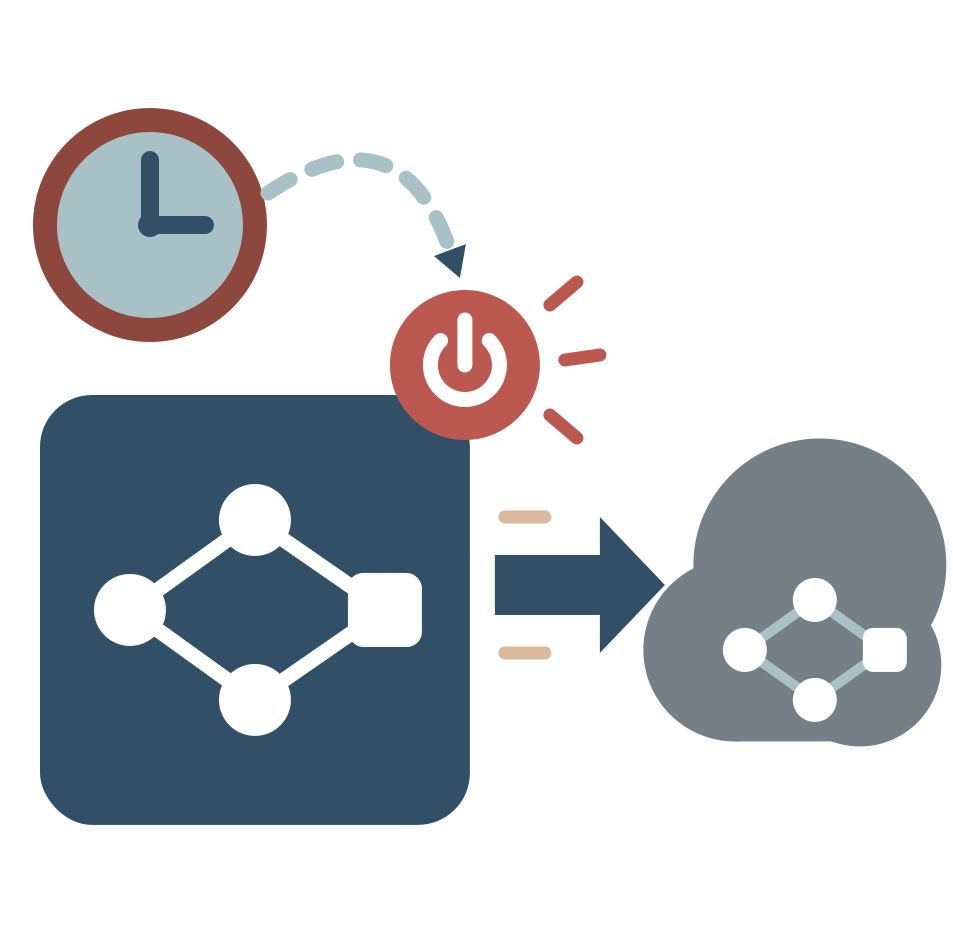
The deadline
Pipedream announced on October 1, 2026 that its Workflows product shuts down on March 31, 2027, and that all workflow data will be permanently deleted by April 30, 2027, including the stored credentials and OAuth tokens for every connected account (announcement). The platform is in maintenance mode effective immediately: no new features, no new signups. Existing workflows keep running until the shutdown date.
If your business runs on Pipedream workflows, every one of them needs a new home in six months. This is not a version bump or a pricing change. The product is going away, and the tokens that let your automations talk to Google, Salesforce, Box, Slack, and the rest go with it.
What the export tool saves, and what it leaves behind
Pipedream provides a per-project export (docs) that produces a ZIP of JSON files describing each workflow: triggers, step order, code for code steps, and component names for no-code steps. It deliberately omits everything sensitive, which is most of what makes a workflow actually run:
- Configured step settings are replaced with
<redacted> - Connected accounts and OAuth tokens are not included
- Environment variables and secrets are not included
- Data stores, file stores, and event history are not included
The export is a skeleton, not a backup. Everything on that second list has to be inventoried and recreated by hand, and it can only be inventoried while the platform is still up.
What migration actually involves
Pipedream quietly handled a lot of infrastructure for you. At shutdown, every row below becomes your problem.
| Pipedream handles this today | What you must do by March 2027 |
|---|---|
| No-code / visual steps | Rewrite each one as real code, or map it to an equivalent on another platform. The export gives a component name and redacted settings, not runnable logic. |
| OAuth to your apps (Google, Salesforce, Box, Slack, and the rest) | Register your own developer app with each provider, pass each provider's review, and build token storage with automatic refresh. |
Webhook URLs (*.m.pipedream.net) | Find every place a provider, form, or partner posts to a Pipedream URL and re-point it to your new endpoint. |
| Schedules and cron triggers | Stand up a scheduler (Cloud Scheduler, EventBridge, or similar). |
| Secrets and environment variables | Inventory them now (they are not exported) and re-home them in a secret manager. |
| Data stores and file stores | Drain any state your workflows depend on and migrate it to a database or bucket. |
| Error notifications | Build your own alerting. Pipedream's built-in error emails disappear with the platform. |
| Event history and replay | Add logging and payload capture if you want to re-run failed events, a feature teams lean on more than they realize. |
| Hosting, deploys, monitoring | A cloud account, CI/CD, and dashboards for the code that replaces the workflows. |
For teams that built visually, the first two rows carry most of the cost: every stock step is a rewrite, and every connection means registering a developer app with a third party whose review queue runs on their timeline, not yours.
Why starting early matters
Six months sounds like time. Three of the clocks inside it are not yours to control:
- Provider app reviews. A Google OAuth app that touches sensitive scopes goes through a verification process that can take weeks. Salesforce orgs under the 2025 default connected-app restrictions need per-org admin approval. These queues get longer as every Pipedream customer files at once.
- Parallel-run time. The safe way to cut over a production automation is to run the replacement beside the original in observe-only mode until it has seen real traffic, including the weird cases. That takes calendar weeks you cannot compress at the end.
- The deletion cliff. Tokens, secrets, and stored data are gone April 30, 2027. Anything not inventoried before shutdown cannot be recovered afterward.
Teams that start in late 2026 get to migrate deliberately. Teams that start in February 2027 are doing a rescue.
How we run a migration
- Inventory and triage. Catalog every workflow through the Pipedream API: live or dormant, trigger type, connected apps, schedules, webhooks. Rank by business impact and complexity.
- Backup beyond the export. Run the official export, then supplement it with full step-code dumps through the API and a hand inventory of what no export captures: environment variables, connection lists, provider-side webhook registrations, data store contents.
- Auth foundation. Register owned OAuth apps with each provider and stand up token storage with automatic refresh in a cloud secret manager. This starts first because provider review timelines are the long pole.
- Port in priority order. Rebuild each workflow on the target platform. New versions run in observe-only mode beside the Pipedream originals until their output matches on real production traffic.
- Cut over. Re-point webhooks, forms, and schedules, switch the new version to enforcing, and watch error rates.
- Decommission. Disconnect accounts, cancel the plan for the prorated refund, and archive the exports.
Steps 1 and 2 are worth doing immediately even if the rest waits. They are the only steps with a hard expiration date: anything not captured before shutdown is gone for good.
Why BubbleUp
We operate a portfolio of production Pipedream workflows for a large enterprise client, and we are running this exact migration for that estate now. The playbook above is being exercised, not theorized. The parts of a migration that stall most teams are parts we have already built and run in production:
- Replaced no-code steps with portable, retry-hardened Node.js code across an entire workflow estate
- Built owned OAuth token infrastructure (provider app registration, cloud secret storage, scheduled refresh) that runs entirely outside Pipedream
- Operate cloud functions on Google Cloud with CI/CD auto-deploy from GitHub
- Integrate daily with Box, Google Workspace, Asana, Salesforce, Formstack, and Canva APIs, including the webhook handshakes and token quirks each one hides
- Scripted full step-code backups through the Pipedream API that capture more than the official export tool does
None of that work transfers directly into your migration. What it proves is that every hard step in the plan above has been done before and holds up in production, so your migration starts from a working playbook instead of a first attempt.
Next step: a migration readiness assessment
A fixed-scope assessment using read-only API access to your Pipedream workspace. You receive:
- A complete inventory: every workflow, live vs. dormant, triggers, connections, and webhook registrations
- A complexity and risk rating for each workflow
- A recommended target platform and migration sequence
- A full backup of every custom code step, plus the identity and version of every no-code component, taken while it can still be taken
The assessment stands on its own if you migrate in-house, or becomes phase one if we do the migration together.
BubbleUp is not affiliated with, sponsored or endorsed by Pipedream or Workday, Inc. Pipedream is a trademark of Workday, Inc.